Walter Carlos, born is 1939, underwent a sex change in 1972 to become to girl he had always wanted to be. He had studied music and physics at Brown University which helped him to do the project he is known for - electronic music for Clockwork Orange. He created a new synthesizer that helped develop the audio for the movie. During Clockwork Orange the song "Singin in the Rain" by Gene Kelly is played during a painful scene of a woman being raped. The song is supposed to be cheerful, light and fun, which contradicts the scene being played out on screen. I think think it is supposed to make the audience feel uncomfortable and it is a sort of irony because Alex's gang treats the violence rape very lightly just like the song.
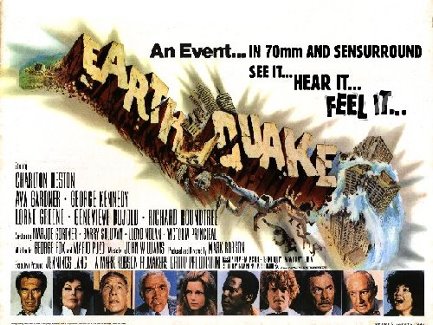
When I asked my parents about the 1974 movie "Earthquake", I didn't get a grand reaction out of them like I was hoping. My dad had never heard of it and my mom said "I think I saw it on VHS in junior high". After I reminded her of the plot, she sort of remembered. She said, "It was a devastating movie and now that I think about it, it remind me of 9/11. People were stuck in this building and it was scary." Obviously she didn't have anything to say about the effects because she didn't see it in the movie theater. The movie was meant to be an "Event Film" to bring the audience back to see the movie again over and over. To make it have impact, "sensurround" was used which meant a bunch of large speakers and an amplifier would create "infra bass" sound waves to make it seem like a real earthquake was happening. People in the audience were not used to these effects and many panicked when seeing the movie. Some ran out, some had heart attacks. It was not for the fatal heart. Even some of the ceiling tiles in the theater would move, making it all more real.
Silent movies may look cool, old and antique to us now, but back in the day, that was all they really had. When audio and video first began to work together making "talking pictures", there were many challenges presented. (Side note - Professor Santiago would wish that I emphasize that Audio and Video are two VERY different and separate things. Yes, they can synchronize but audio did it's own completely separate and video did it's own thing). One of the challenges was the microphone, because they were not very high-tech in the beginning. The microphone had to be positioned so that the sound was consistent in volume even when the actors and actresses turned their heads or away from each other. Another challenge was the synchronization. This meant they had to get the audio to match the video so every word, expression and sound matched together with the lip movement and motion of objects. Actress Myrna Loy said to New York Times writer Guy Flatley in 1977, ‘This is ridiculous! Who wants to hear people talk?" Many People didn't understand why there needed to be a change. Silent films were appreciated because that's all they had and weren't used to talking pictures. People didn't understand them. It is like how I often go to the movies and purposely choose the normal movie over the 3D version, because I just don't see why it's necessary sometimes. Sound affected every person in film though. It must have been extremely frustrating for the directors, producers, and confusing for the actors and actresses who were forced to change their job description. Singing in the Rain from 1952 is a great example of a movie made right at the beginning of the sound in film era.
"The Great Train Robbery" was filmed in 1903 by Edwin Porter. The following is a list of observations while watching it on the effects and camera angles.
-When the robbers first boarded the train I noticed how camera moves along and you can see from the train opening how quickly the train is moving as the surrounding whiz by.
-the smoke when the explosive sets off inside one of the train cars was colored when the
-As the robbers move on top of the train, the camera is positioned in the back of the train so that the audience can see what they are doing, and feel as if they are on the train moving with it.
-the camera gives a perspective of the size of the train and when all the people jump off and put their hands up, you can see the big jump to the ground.
-when the man who tries to escape runs out of the crowd and towards the camera, it symbolizes that where we are as the audience is freedom and escape from the robbers, yet he is shot.
-To me the camera felt like a third-party bystander, like someone watching from the outside looking in. Perhaps this was because of the lack of sound. The people who the train robber's stole from and killed were avenged in the end as they were shot themselves and had their stolen possessions stolen once again.
------------------------------------------------------------------------------------------------------------
"Napoleon" is a French silent film directed by Abel Gance in 1927 that depicts the Napoleon's life in his earlier years. The reason why it is famous is because of the fluid camera motion. Most films during this time had a lot of static. The following are new innovative effects used in the film that were fairly new in the technological world -
-Fast cutting
-Extensive close-ups
-hand-held camera shots
-location shooting
-point of view shots
-multiple-cameras
-multiple exposure
-superimposition
-underwater camera
-kaleidoscopic images
-film tinting
-split screen
-mosaic shots
Georges Melies' black and white twelve minute film from 1902 was the first science fiction film and first animation. film was projected at 16 frames per second, which was how films were measured in the earlier film days, and this actually was the standard frame rate at the time. You would think Melies would have made a nice profit, writing, directing and producing the first fiction film and animation, but unfortunately Thomas Edison's film technicians were secretly (now what would be called 'illegally') making copies and selling them. This film came right before the Nickelodeon Era, where people could pay 5 cents (NICKELodeon) to individually view a movie.
During this film, a rocket is carefully constructed and the shell is seen being launched. Then "the shell pierces the eye of the moon", which to me looks like a giant cheese pizza with a face. The animation of it is the comedy of the film, quite different than comedy today. The shell crashes down and the men who had been contained inside get out and explore the landscape. There are stars with women for faces, explosions, and snow. This is before the astronomers are captured and taken to the King. At last, the shell drops into the sea. This film not meant to be serious, but a narrated fiction with real people and a fake background.
After viewing the Stage Door blog and looking at all of the videos, I have selected 7 to share along with a description of why I thought the technology added to the clip.
1. The video begins off dimly lit but quickly the special effect of lightening wakes the audience up using visual and sound effects. Then towards the middle, the mixture of red and yellow spotlights creates a warm friendly environment and the use of background dancers excites the crowd. At all times, a mixture of smiling people surround Harris as he sings out about the proposition of life becoming more like theater. If that were true, we would need a constant crew of people trailing us around the handle the lights, camera, make-up, costumes etc.
2. If you watch the curtains behind the bed right as the video begins, you can see light coming from behind them and you can see them blowing which gives off a feel of outdoors in her bedroom as she sings. Also if you look at the ground around 2:05 you can get a good view of a colorful disco effect. There are several blue green and yellow circles spiraling across the ground the give the whole scene a star-gazing kind of feel.
3. In the video, the entire set is the yellow couch upon which Kristen sits, but the use of the spotlight that follows her around on stage makes her shine even brightly as she sings. I laughed at the interaction between her and the orchestra in the beginning. It made the audience laugh and reminded me that music really is a technology because it is one of the main factors when it comes to mood.
4. Oh my gosh! The amount of colors, extravagant costumes, lights and glitter. I see the electric "passionelle" sign in 0:04, petals falling from the sky in 0:25, and the black background with the twinkling sparkles in 2:45. This Broadway show seems to revolve around glitz and glamour at first glance but as I watch the brief previews of the rest of the clips it seems to be a conflicting tale based on Genesis from the Bible. Any show with Kristen is entirely glamorous in my opinion.
5 and 6. Look at the difference between the sets and costumes in the first video in 1960 and the second from the 21st century! I am just amazed how far theater has come. The 1960 Peter Pan video reminds me of the video style from the Brady Bunch. Their costumes are a plain cloth brown while the second video has belts, colors, different textures and add-ons. The background in the second video is also much more elaborate. The trees in the 1960 video look crafted by an elementary school child whereas the audience can really believe Peter is in a mystical world in the more modern video. The updated technology gives the story a more "real" feel.
7. While most stages have three walls and one "fourth/imaginary" wall, this stage is very uniquely set up, sort of like a game show. The walls and floors both lit up and the lights not only change color but move. This video has similar technologies to the Patrick Neil Harris video. The flashier stages also tend to break the fourth wall (like Glitter and Be Gay). I think it would have been an added touch if the inner circle of the circular stage span while everyone was singing in unison. If not possible, they could make the stage rise at the end and then when the lights go off, an attached staircase at the end would get them down safely.
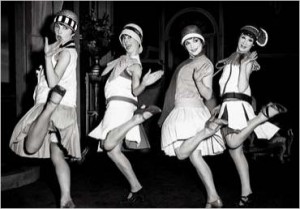
If you go to any dance club today, you might be appalled at the moves you see on the dance floor. This is how many people felt about the Charleston! If you have never seen the Charleston live before let me give you a brief summary. This dance can be done by yourself, with a partner or in a line. It involves kicking of the legs and swinging of the arms done oppositely. There are four basic moves done loosely with the limbs. The dance was done mostly by flappers, rebellious young women who cut their hair short, wore bright lipstick and wore shorter hems. This dance was a representation of enthusiasm and life, and a way for people to express themselves. The Charleston was a precursor to the Lindy Hop, another popular dance from the 1930s. It is amusing to us how flappers and Jazz music were so scandalous because of our culture today, and makes me wonder what the dress and social change will be like in the next decades to come.
When Jazz Music was especially popular in the early 20th century, it also served as a symbol for social change. Black musicians were beginning to be able to record or be known as artists. It was a gateway that helped many people have less prejudice towards the African American race during the Civil Rights Movement. Jazz music was a culmination of black music, spirituals, gospel, and music from the westindies. A few famous black jazz musicians were Louis Armstrong, Tommy Dorsey and Duke Ellington.